What is non-invasive ventilation (NIV)?
NIV is a treatment used in the management of respiratory conditions, to help with your breathing. You may also hear us refer to this treatment as ‘BIPAP’ or ‘Bi-level positive airway pressure’.
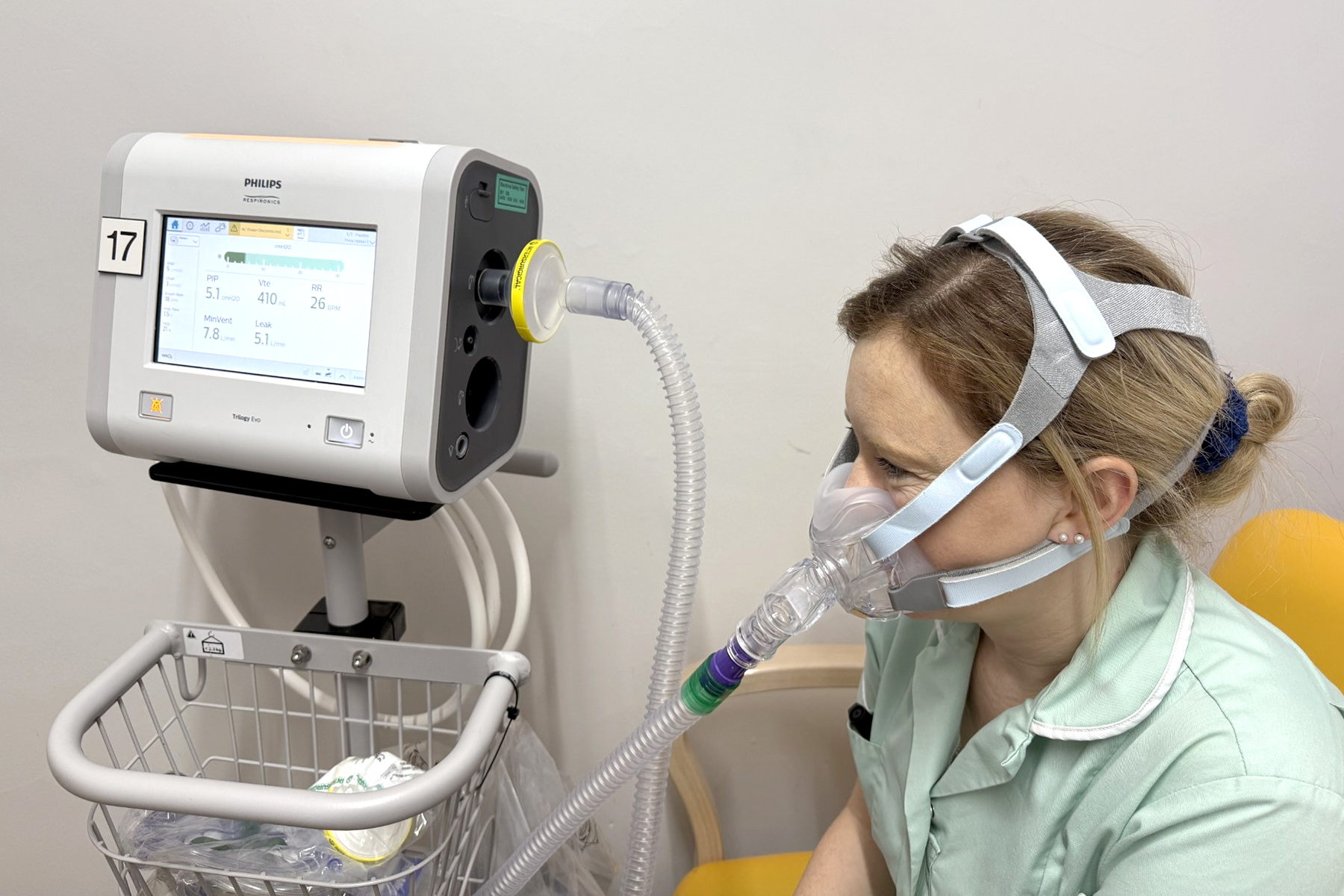
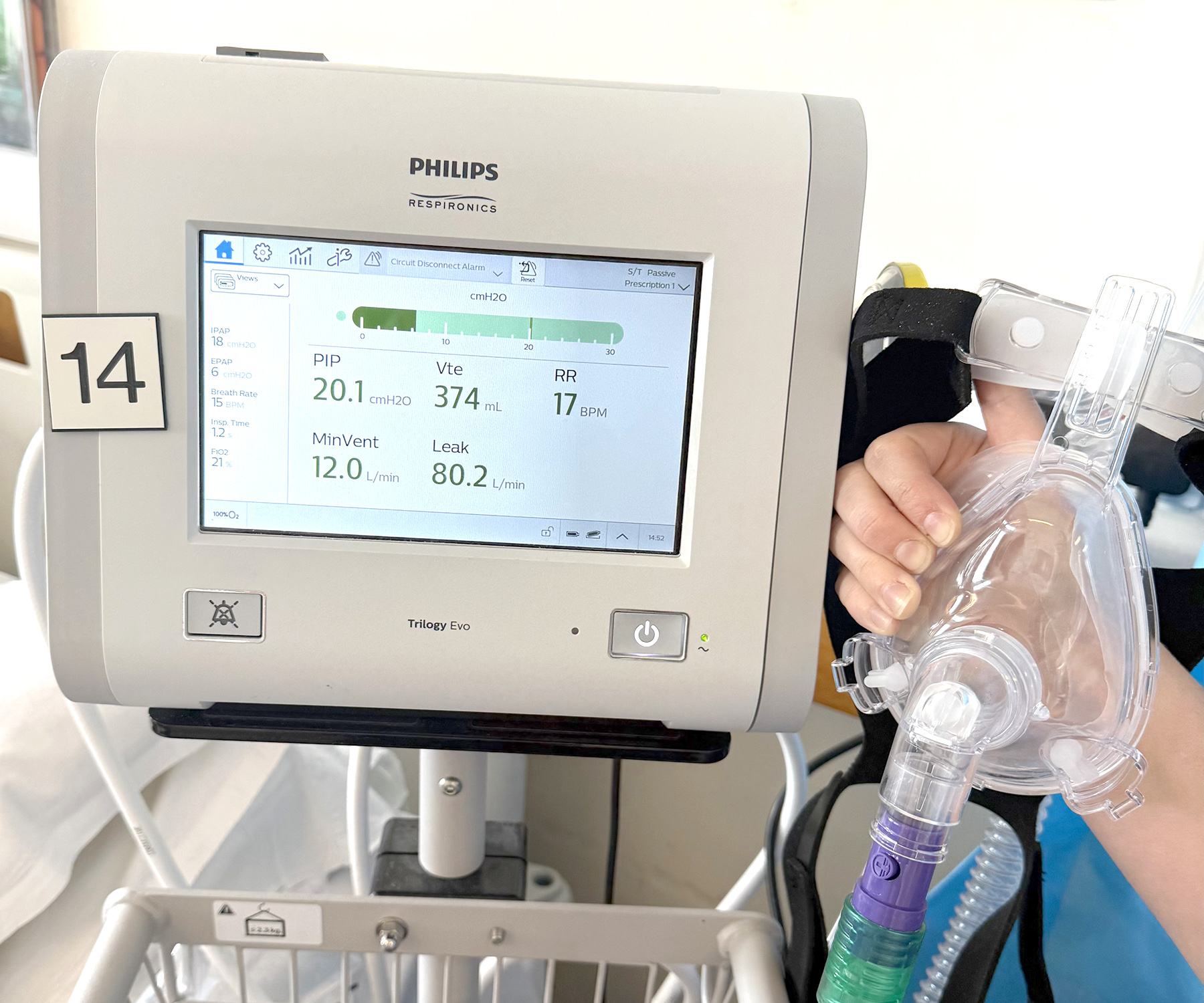
NIV is a bedside machine with a tube and a cushioned mask worn over your nose/mouth or under your nose to treat the build-up of carbon dioxide in the body. The machine gives a stream of air into the lungs to support breathing muscles and make breathing easier.
Conditions we may use NIV in include: chronic obstructive pulmonary disease (COPD), chest wall deformity, obesity hypoventilation syndrome and neuromuscular disease.
Why do I need NIV?
When we breathe in, we inhale oxygen. When we breathe out, we exhale carbon dioxide as a waste product. For people with respiratory conditions, breathing can become hard work, especially during a flare up of symptoms or infection.
This can lead to your breathing muscles becoming tired and not working as efficiently. This may lead to a reduction in the oxygen levels and an increase in the carbon dioxide levels in your blood.
High carbon dioxide levels can make you feel tired, drowsy, confused and short of breath.
A blood test from your wrist will be required to assess these levels.
What does NIV do?
The machine does not breathe for you, but gently assists each breath that you take, to allow your respiratory muscles to rest.
The machine delivers two pressures: one as you breathe in and one as you breathe out.
The pressure delivered as you breathe in facilitates a bigger breath to help you breathe out carbon dioxide. The pressure delivered as you breathe out helps to keep your lungs in an open state to improve your oxygen levels.
Additional oxygen can be delivered through the machine.
Are there alternative treatments to NIV?
Sometimes your carbon dioxide levels can improve with medical treatment such as controlled oxygen therapy, antibiotics, nebulisers and steroids. However, if bloods do not come back into normal range within one hour of medical treatment, NIV may also be started.
If you are drowsy and not alert a decision will be made in your best interests to start NIV by a doctor. Once you are more alert, if you have concerns about having NIV in the future you should discuss this with a respiratory doctor.
What does NIV feel like?
You will feel a flow of air from the machine, as you breathe out there will be a little resistance to help keep your lungs open. It is sometimes described as breathing against a strong wind.
As the machine provides a flow of air, a tight seal is required from the mask. The mask is secured in place using straps that fit around your head.
We have different types of mask we can trial to try and get the most comfortable fit for you.
We can also apply a pressure relieving pad to reduce pressure on the bridge of your nose from the mask.
What happens during NIV?
Once a mask has been fitted and the machine is started, you will start to feel a stream of pressure helping with your breathing. Pressures will start lower and may slowly increase to ensure you are taking adequate breaths.
You will be monitored closely with regular observations recorded. If an alarm sounds on the machine, please do not touch or worry, a staff member will see to this.
It is likely the mask may just need refitting. A team of doctors, nurses and physiotherapists will look after you and be available if you have any problems or questions.
How do you know if the treatment is working?
After the first hour of treatment, another blood test from your wrist should be taken.
The results from this blood test will be compared to your initial blood test to check there has been some improvement.
If there is some improvement but your bloods are not yet normal, we will continue NIV treatment and take another blood test in 4-6 hours.
If there is no improvement, we may discuss changing settings on the machine to help.
Can I eat and drink during NIV?
When you are first started on the machine you may be drowsy due to your high carbon dioxide levels and unable to eat and drink safely.
Once you are more alert, you can start to have short hydration and pressure relief breaks from the machine under staff supervision.
Initially we want to limit time off the machine to give your carbon dioxide levels time to reduce.
Once your bloods have normalised you should be able to trial short meal breaks off the machine and eat and drink as you normally would.
How long does treatment last?
NIV will be weaned over the course of a few days, with slightly longer breaks from the mask each day.
As the machine is assisting with your breathing we have to wean it gradually to allow your body time to recover and your breathing to improve.
Everybody will wean from the machine differently and breaks will be agreed with you daily.
If you have any further questions or concerns about NIV please discuss this with a Respiratory Doctor, Nurse or Physiotherapist.
If your concern does not resolve, you can also contact our Patient Advice and Liaison Service their details are below.
Patient Advice & Liaison Service (PALS)
The team are available to help with any concerns, complaints or questions you may have about your experience at the Trust. Their office is in the Main Foyer (Gate 4) of Doncaster Royal Infirmary. Contact can be made either in person between the hours of 9am-3pm, by telephone or email.
The contact details are:
Telephone: 01302 642764/642767 or 0800 028 8059
Email: dbth.pals.dbh@nhs.net
Content out of date? Information wrong or not clear enough? Report this page.