On this page:
- What our Commitment to Cleanliness Charter means
- Protected meal times
- What we clean and how often
- Our promises to you
- How you can help
What our Commitment to Cleanliness Charter means
- We want the ward or department to be clean and safe.
- Everyone helps keep the hospital clean: managers, nurses, cleaners, patients and visitors.
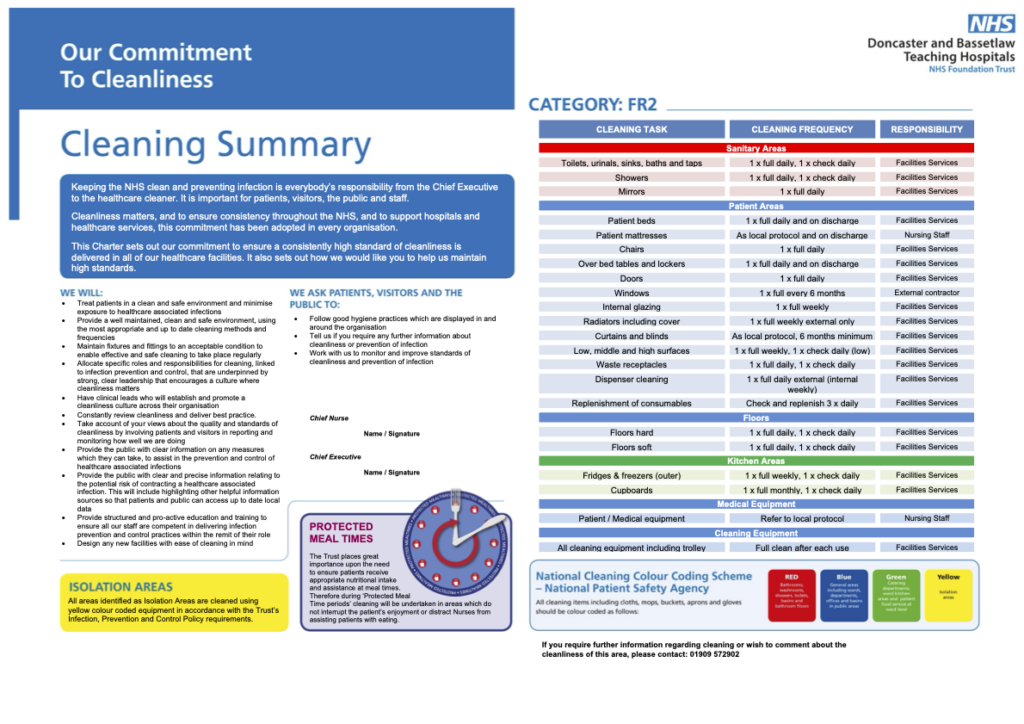
- Some areas are Isolation Areas. These are cleaned with yellow equipment to stop infection spreading.
You will see a Cleaning Summary poster below in ward areas.
Protected meal times
- Meal times are special and important.
- During meal times:
- Cleaning is done away from patients.
- Nurses are not disturbed, so they can help patients to eat.
- This helps patients get the food and support they need.
What we clean and how often
Sanitary areas (toilets, sinks, baths, showers)
- Cleaned every day.
- Checked again later in the day.
- Done by Facilities Services.
Patient areas (beds, chairs, lockers, doors, windows, surfaces)
- Beds and lockers: cleaned every day and when a patient leaves.
- Mattresses: cleaned by nurses following local rules and when a patient leaves.
- Chairs, doors, surfaces: cleaned every day.
- Windows and curtains: cleaned regularly (for example every 6 months or weekly).
- Done mainly by Facilities Services.
Floors
- Hard and soft floors: cleaned every day and checked again later.
- Done by Facilities Services.
Kitchen areas
- Fridge and freezer outside: cleaned every week and checked daily.
- Cupboards: cleaned every month and checked daily.
- Done by Facilities Services.
Medical equipment
- Cleaned by Nursing Staff following local rules.
Cleaning equipment (trolleys, mops, cloths)
- Cleaned after each use.
- Done by Facilities Services.
Our promises to you
We promise to:
- Treat you in a clean and safe place.
- Reduce the risk of infection as much as possible.
- Keep the building, fixtures and fittings in good condition so they can be cleaned properly.
- Make sure roles and responsibilities for cleaning are clear.
- Have strong leadership so cleanliness is taken seriously.
- Review and improve cleanliness all the time.
- Listen to your views about how clean the ward or department is.
- Give clear information about infection and how to prevent it.
- Train our staff so they know how to prevent infection.
- Design new areas so they are easy to clean.
Signed by:
- Chief Executive
- Chief Nurse
How you can help
You can help by:
- Following good hand hygiene and other hygiene signs around the ward.
- Asking if you want more information about cleanliness or infection.
- Telling us if you see something that is not clean or worries you.
Content out of date? Information wrong or not clear enough? Report this page.