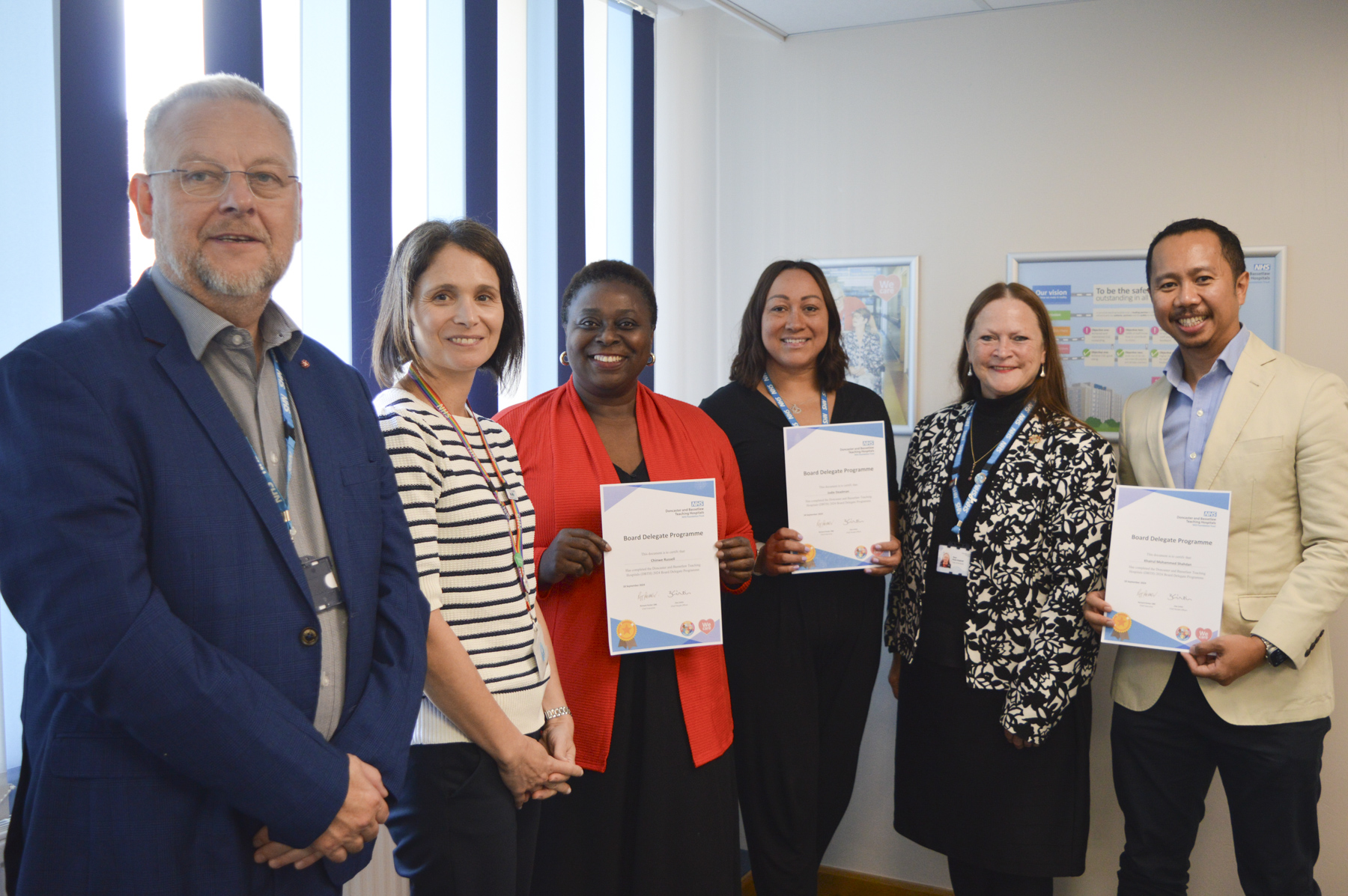
The five-month voluntary programme, launched in 2023, was primarily established to nurture future talent from under-represented communities.
It teaches individuals, from both the private and public sector, the skills needed to progress to an Executive or Non-Executive Director (NED) position within a large and multifaceted organisation.
Jodie Deadman, one of this year’s successful cohort, said: “I commend the Trust on their openness. To invite people from inside and outside both the organisation, and the NHS, and allow what felt like an unfiltered involvement is just excellent.
“Access to the Executives and NEDs was excellent and the knowledge and expertise within these roles are vast and gave me invaluable insight. Moving from informal conversations to seeing that in action, both as a chair of a subcommittee and then on the board itself, was really helpful.
Delegates are paired with a Trust Executive Director and gain access to coaching and various support resources. They are invited to attend public and committee meetings, as well as participate in hands-on sessions.
Jodie went on: “I have been so impressed with the organisation that when I am ready, I would absolutely look to consider, or rather be considered, for a role at DBTH.”
“Thank you once again to the team and the organisation for embracing and delivering something very different to traditional or academic learning.”
The program benefits both the delegate and the Trust, with candidates providing invaluable insights to the Trust’s board-level leaders such as challenges faced by local communities and how the organisation can create more opportunities for underrepresented groups.
Dr Khairul Shahdan, another successful delegate, felt uninspired following his tenure as a Consultant in Emergency Medicine in 2022.
He explained: “I didn’t want to take on any other leadership roles due to the sheer responsibility. However, my divisional director encouraged me to apply and I’m glad I did.
“I’ve learnt the value of having diverse and inclusive executives and NEDs bringing their experience and depth for queries and assurance. I was also proud to see that clinical safety was upheld as the utmost priority despite trust financial pressures.
“The programme has encouraged me to do a lot more self-reflection. A lot us dream and talk about world class legends but are not prepared to do world class and legendary work.
“I’ve learnt new terms and language used at board-level which I wasn’t exposed to as I am trained as a clinician. There’s been a lot to read and having spoken to one of the previous board delegate members, you certainly get what you put into this programme.”
“I would definitely recommend this programme to those aspiring to be board-level members and I am more than happy to chat to those who want to ask me anything more about it.”
Following the completion of the programme, candidates are given support and guidance in preparing materials to apply for Executive and Non-Executive Director roles.
Chinwe Russel was the third successful candidate this year.
She said: “What particularly struck me was the level of organisation that goes into each board meeting that I attended. It made me realise how prepared one must be to participate effectively and fully.
“I could clearly see the difference between board members who are internal to NHS and those who were not regarding subject matter requirements, the level of scrutiny, seeking assurance and more.
“It was a pleasant surprise to learn that the public could participate in the meetings. This level of transparency is something that I will carry forward in my professional life.
“Thanks to the experience and confidence that I gained, I have secured a management position in an organisation in London.”
Jodie, Chinwe and Khairul now join a growing community of delegates who have successfully completed the programme.
The next Board Development Programme will open for applications in March 2025. For the latest updates on the next programme, keep an eye on our website: www.dbth.nhs.uk