
Governors help Doncaster and Bassetlaw Teaching Hospitals (DBTH) stay connected to the communities we serve. They represent the views of patients and the public, bringing local insight to help shape how services develop.
We’re looking for people from all walks of life who are willing to speak up and make a difference. You don’t need specific qualifications —just an interest in local healthcare and a commitment to representing your community.
By becoming a Governor, you’ll help ensure a wide range of voices are heard and play a part in improving care for patients across Doncaster and Bassetlaw.
On this page, you’ll find all the information you need to understand the role, learn more about our Trust, and complete your nomination to stand. Whether you’re exploring the opportunity or ready to apply, everything you need is right here.
Complete your nomination: From 21 May to 5 June visit www.cesvotes.com/DBFT2026 to complete the nomination.
Skip to a section:
- Our Trust
- Our vision, values and strategy
- The role of a Governor
- Could I stand as a Governor
- How elections work and stand

Our Trust
We are one of Yorkshire’s leading acute trusts, serving a population of over 440,000 people across South Yorkshire, North Nottinghamshire and the surrounding areas. With over 7,300 colleagues, we operate three main hospital sites – Doncaster Royal Infirmary, Bassetlaw Hospital and Montagu Hospital – delivering a full range of healthcare services, including emergency, inpatient, outpatient, diagnostic and specialist care.
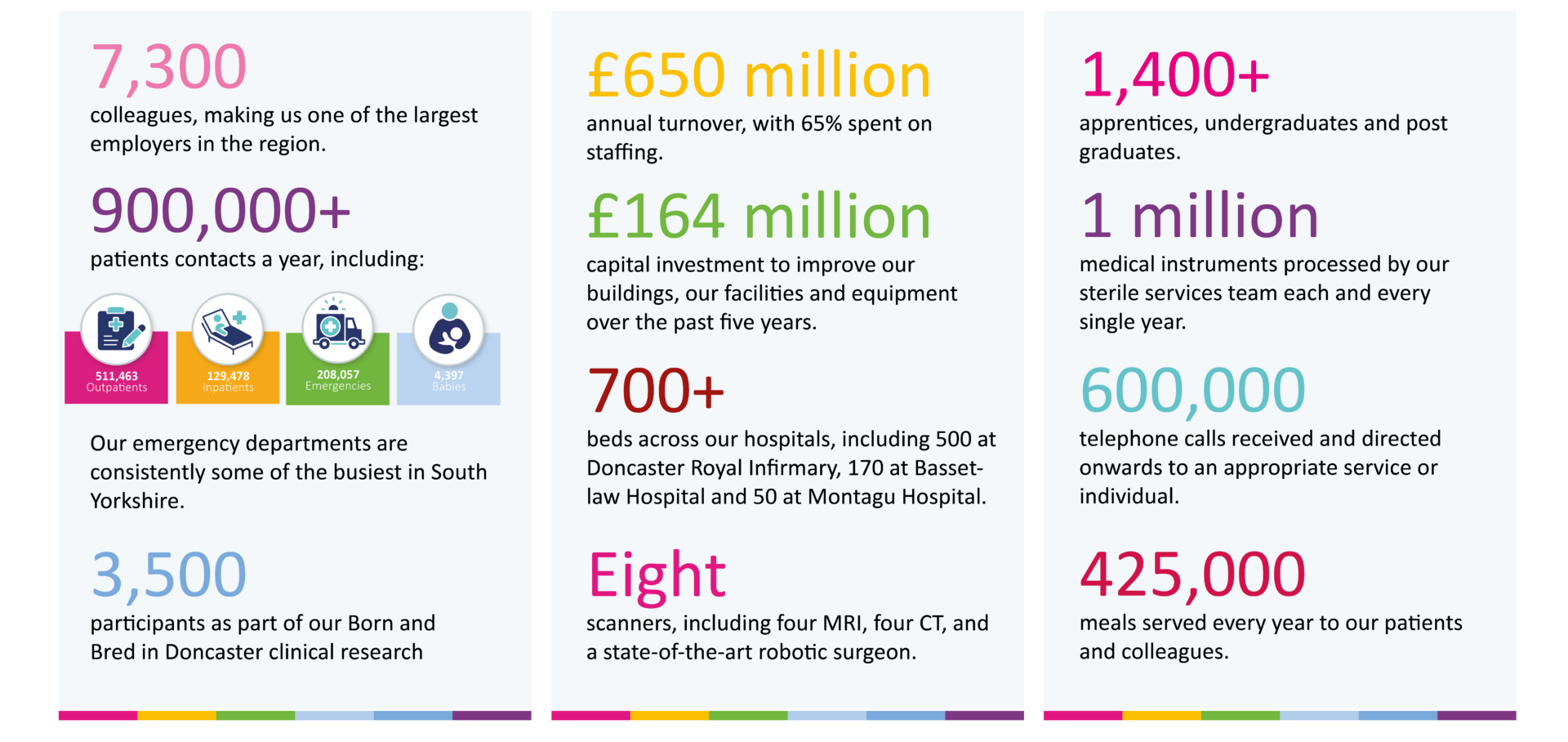
We also provide outpatient and diagnostic services at Retford Hospital, including medical imaging and clinical therapies. Our Audiology service is based at Sandringham Road Centre, while Mammography and Children’s Speech and Language Therapy are delivered from Devonshire House—both located within two miles of Doncaster Royal Infirmary.
As a teaching hospital, we play a key role in training future health professionals, supported by strong partnerships with local universities and a growing research and innovation profile. We are proud to be values-driven, patient-focused, and committed to continuous improvement, working together to provide outstanding care for our communities.
You can read more about our Trust, and our achievements, within our Annual Reports, as well as our activity in 2024/25 here. You can also meet our Board of Directors here.
Our vision, values and strategy
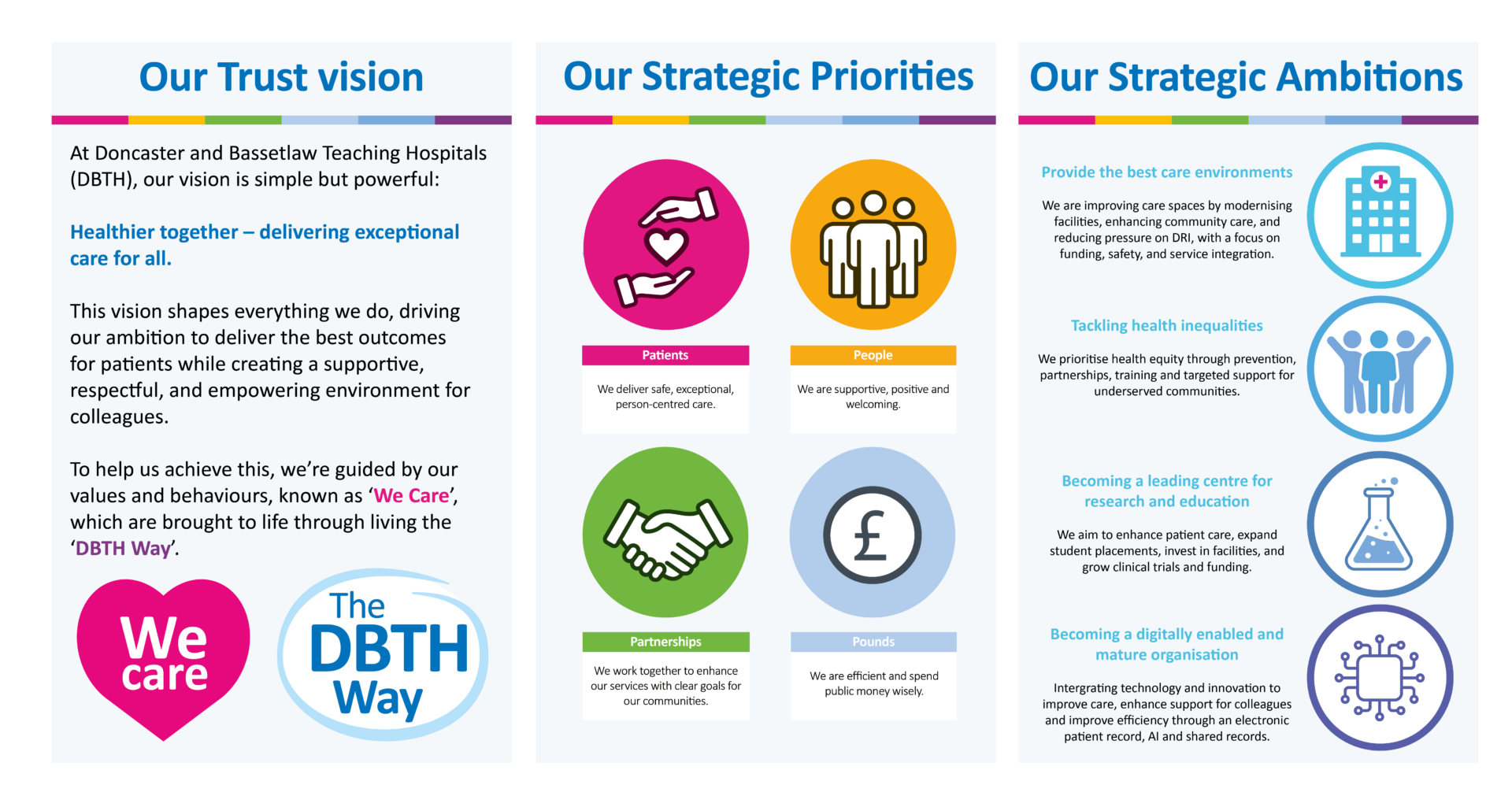
Our Strategy is shaped by our vision, underpinned by our values, and delivered through clear priorities and bold ambitions. Our refreshed strategy – Healthier Together – is available here and our Enabling Plans, here.
The role of a Governor
Please note: Our next round of nominations and elections begins 21 May 2026. You must be a Trust member to stand – to ensure you are eligible, join here.
As a Governor, your role is to engage with members and the wider public, making sure their voice is heard.
You act as a key link between the organisation and the communities it serves. Governors advise on the needs of patients and the public, and suggest ways to involve them in shaping and delivering services.
As ambassadors, Governors promote the work of the organisation and support it to operate in a way that reflects its purpose, values, and statutory responsibilities.
While the way organisations involve patients, colleagues and communities may continue to evolve over time, the importance of strong local insight and meaningful engagement remains central to this role.
Core responsibilities of the Council of Governors
Collectively, the Council of Governors is responsible for:
- Holding Non-Executive Directors (NEDs) to account for the performance of the Board, while representing the interests of members and the public.
- Appointing and, if necessary, removing the Chair and Non-Executive Directors.
- Setting the pay and conditions of employment for the Chair and NEDs.
- Approving the appointment of the Chief Executive.
- Appointing or removing the organisation’s auditors.
- Approving significant transactions, including mergers, acquisitions, separations or dissolutions.
At present within the Trust, our Council of Governors is made up of:
- Six Staff Governors.
- Eight Public Governors (Doncaster).
- Three Public Governors (Bassetlaw).
- Up to six Partner Governors.
- One Public Governor (Rest of England Wales).
Looking ahead, expected legislative changes from 2027, linked to the Government’s 10-Year Health Plan, may reshape how Councils of Governors operate and the role they play within NHS Foundation Trust governance. If enacted, this would signal a shift away from the formal governor model towards more flexible, locally designed approaches for engaging patients, colleagues and communities in accountability and oversight.
Expectations of the role
Governors are expected to play an active part in the work of the Council.
This includes:
- Attending Council of Governors meetings (held at least four times a year).
- Attending the Annual Public Meeting.
- Taking part in training and development sessions.
- Asking questions and contributing across meetings to support effective oversight.
Some meetings will take place in person on site.
Could I stand as a Governor?
You need to be 16 or over and registered as a member of the Trust to stand for election as a Governor. You can check you are a member by contacting the Deputy Company Secretary on 01302 644157.
If you are not a member – you can join here.
You don’t need any formal qualifications to be a Governor. Some Governors have previous experience of working with their local communities while others bring skills that they have gained through paid or voluntary work.
Full induction and training required will be provided along with regular online briefing events.
We ask that prospective governors have a good level of IT literacy, so they can join virtual meetings and are comfortable communicating via email correspondence.
Whilst there are no qualifications needed, you may not become an elected governor if:
- You have been declared bankrupt;
- You have made a composition or arrangement with, or granted a trust deed for, creditors and have not been discharged in respect of it;
- You have been sentenced to prison for three or more months within the last five years;
- You have completed the maximum 9 year term as a governor or been dismissed as a governor.
There are other reasons why you may not be able to be a Governor so please contact the Company Secretary on the number above if you’d like to stand for election but think there might be an issue.
How do Governor elections work and standing
An external agency runs the elections, to make sure that they are completely impartial. Nominations and ballot papers are handled by this external agency and the agency sends out information to all members to enable them to vote.
Candidates are given the opportunity to write a brief statement about why they are standing for election, to introduce themselves to members and encourage people to vote for them.
Four seats are up for election in 2026; successful candidates will be elected for a three year term of office. Vacancies are as follows:
- Doncaster public (six seats)
- Bassetlaw public (two seat)
- Rest of England and Wales (one seat)
- DBTH colleagues (four seats, one in each class: Non-clinical, nursing and midwifery, other healthcare professionals and medical and dentistry).
Ballot papers will be sent to all registered members within the constituencies where an election is to be held. A ballot will only be held where there are more nominations than vacant seats. The election system to be used is known as Single Transferable Vote (STV).
The 2026 election timetable is as follows:
- Notice of election/nominations open: 21 May 2026
- Nomination deadline: 5 June 2026
- Summary of nominated candidates published: 8 June 2026
- Final date for candidate withdrawal: 10 June 2026
- Notice of poll published: 24 June 2026
- Voting packs despatched: 25 June 2026
- Close of ballot: 15 July 2026
- Declaration of results: 16 July
A candidate may not incur any expenses or make a payment of any nature for the purposes of an election.
How do I stand?
From 21 May to 5 June, visit www.cesvotes.com/DBFT2026 to complete your nomination.
Please note, you must be a member of the Trust – if you are not a member – you can join here.
If you require any further information please contact the Deputy Company Secretary on 01302 644157 or email dbth.trustboardoffice@nhs.net

Content out of date? Information wrong or not clear enough? Report this page.